☢️ Nuclear Fallout: The Invisible Threat After a Nuclear Event
- TIM T
- May 4
- 2 min read

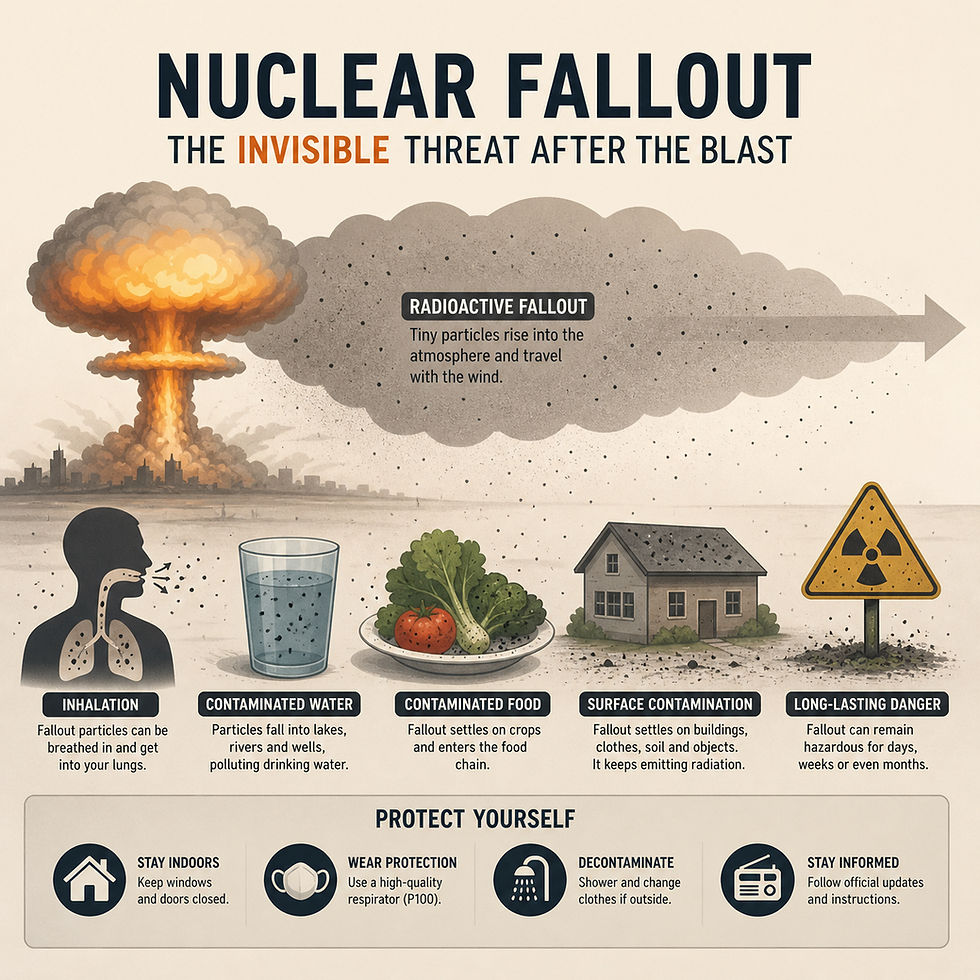
When people think about a nuclear explosion, they often imagine the blast itself. However, the real long-term danger is radioactive fallout — a silent, invisible threat that can spread far beyond the initial explosion zone.
Understanding nuclear fallout risks and how to protect your family is essential in today’s uncertain world.
🌫️ What Is Nuclear Fallout?
Nuclear fallout refers to radioactive particles released into the atmosphere after a nuclear explosion. These particles are carried by wind and eventually fall back to the ground, contaminating everything they touch.
Unlike the explosion itself, fallout can:
Travel across entire regions and countries 🌍
Remain hazardous for days, weeks, or even months ⏳
Spread through air, water, and food chains
This makes fallout one of the most dangerous aspects of nuclear exposure.
💨 How Fallout Spreads
After a nuclear detonation, radioactive debris rises into the atmosphere and forms a cloud.
This cloud can:
Be carried by wind over hundreds or thousands of kilometers
Affect areas far away from the original blast
Create widespread contamination across large regions, including the Middle East
👉 Distance alone is not protection.
🫁 Why Fallout Is So Dangerous
The biggest risk of radioactive fallout is internal exposure.
You don’t need to see it to be affected — fallout can enter your body through:
Breathing contaminated air
Drinking polluted water
Eating contaminated food
Once inside the body, radioactive particles can cause long-term health damage.
⏳ How Long Does Fallout Last?
Many people assume the danger disappears quickly — this is not true.
Radioactive fallout can:
Stay in the environment for days to weeks
Continue emitting radiation over time
Settle on surfaces, clothing, and buildings
This creates a persistent exposure risk even after the initial event.
⚠️ The Biggest Mistake: Waiting Too Late
In a real emergency scenario, demand for protection equipment rises immediately.
At the same time:
✈️ Air freight becomes restricted
📦 Logistics channels become limited
❌ Supplies become difficult to obtain
If you wait until a nuclear event happens, it may already be too late to secure proper protection.
🛡️ How to Protect Against Nuclear Fallout
Effective fallout protection requires more than just staying indoors.
✔️ Key protection methods:
Stay inside and seal windows and doors 🏠
Avoid exposure to contaminated surfaces
Decontaminate after outdoor exposure 🚿
Use proper respiratory protection (P100-level recommended)
🧥 Why Professional Radiation Protection Matters
Standard protective gear is often not enough in high-risk environments.
Professional solutions, such as full-body radiation protection suits, provide:
Barrier protection against radioactive dust
Reduced exposure to contaminated environments
Added safety in extreme conditions
When combined with proper filtration systems, they significantly improve survival chances.
👨👩👧 Final Thoughts: Preparation Is Protection
Radiation safety is not about fear — it’s about preparation.
Nuclear fallout is unpredictable, invisible, and long-lasting.
But with the right knowledge and equipment, you can reduce the risks significantly.
👉 Preparing today means protecting your family tomorrow.


